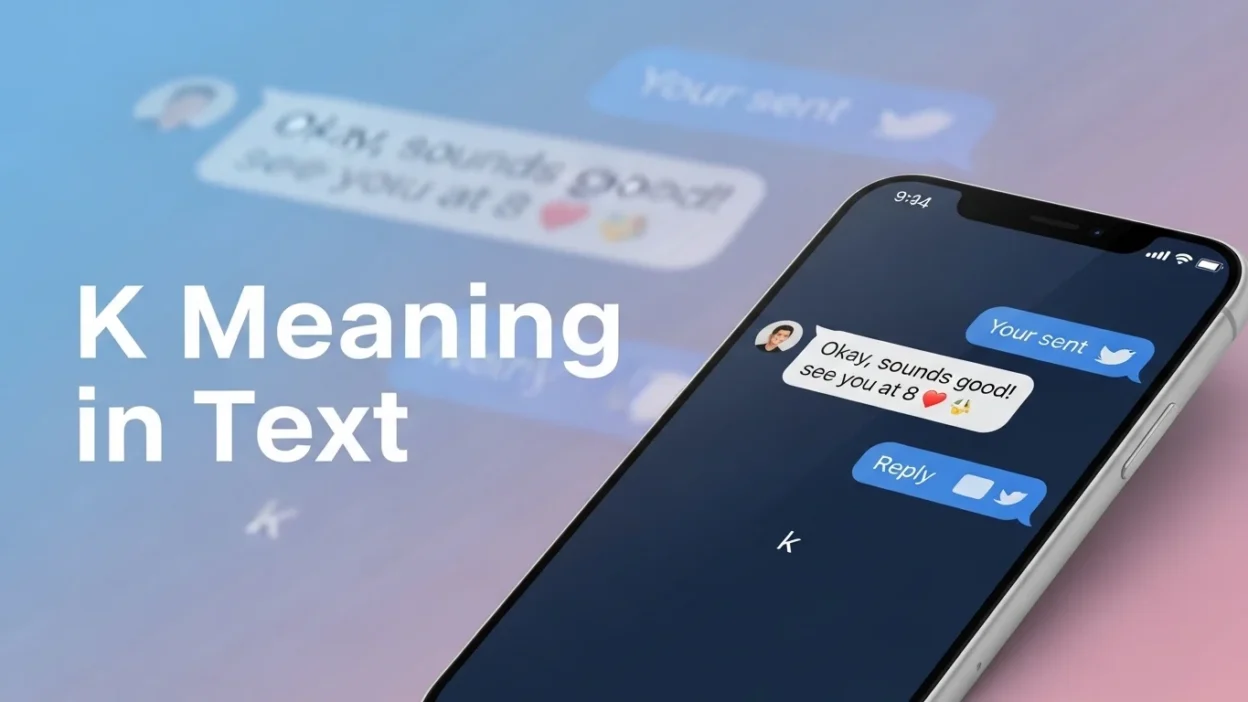
I still remember the first time someone replied to my long message with just one letter: “k.” I had typed three full lines explaining my plan, asking questions, and even adding emojis. The reply? Just… “k.”
I stared at my phone thinking, Are they mad? Did I say something wrong? It felt short. Almost cold. But later, I realized it wasn’t always that deep. In texting culture, even one tiny letter can carry a full meaning.
If you’ve ever wondered about the K meaning in text, you’re in the right place. Let’s break it down in the simplest way possible.
Quick Answer
“K” in text means “okay,” but depending on the situation, it can sound neutral, casual, dry, or even slightly annoyed.
What Does K Mean in Text?
The K meaning in text is simple at its core.
Full Form
K = Okay
That’s it. Just one letter replacing the full word “okay.”
In texting abbreviation culture, people shorten words to type faster. Instead of writing four letters, they use one. It saves time and keeps conversations moving quickly.
Plain-English Explanation
When someone sends “k,” they usually mean:
- Okay
- I understand
- That’s fine
- Got it
- Sure
But here’s the important part: tone depends on context.
Because it’s so short, it can feel:
- Neutral
- Casual
- Uninterested
- Annoyed
The meaning stays “okay,” but the feeling can change.
Why Do People Use “K”?
People use this chat shorthand because:
- It’s fast
- They’re busy
- They want a quick reply
- They’re ending the conversation
- They don’t feel like typing more
In modern texting culture, speed matters. A one-letter reply gets the job done.
Example Sentence
“i’ll be there in 10 minutes”
“k”
Here, “k” simply means “okay.”
In simple terms: K in text means “okay,” but the tone can feel different depending on the situation.
Where Is “K” Commonly Used?
The online chat meaning of “k” appears mostly in casual conversations.
You’ll see it in:
- Text messages
- WhatsApp chats
- Instagram DMs
- Snapchat conversations
- Group chats
- Gaming chats
- Online forums
It is rarely used in professional emails or formal writing.
Tone of “K”
- Mostly casual
- Very informal
- Sometimes neutral
- Rarely appropriate in formal settings
With close friends, it feels normal. In serious conversations, it can feel dismissive.
That’s why context matters so much in social media slang.
9 Realistic Conversation Examples (Lowercase Style)
Here’s how “k” looks in real texting situations:
- “don’t forget the meeting at 5”
“k” - “i’ll call you later”
“k cool” - “we need to talk”
“k…” - “be ready in 15”
“k coming” - “sorry i couldn’t make it”
“k it’s fine” - “i’m outside”
“k” - “can you send the file?”
“k will do” - “i’m really upset about this”
“k” - “movie at 9?”
“k bet”
Notice how example #8 feels different? Same letter. Different tone.
Why “K” Sometimes Feels Rude
Even though the text slang meaning is just “okay,” it can feel rude because:
- It’s very short
- It shows little effort
- It doesn’t add emotion
- It can seem dismissive
If someone sends a long emotional message and gets “k” back, it might feel cold.
But in quick plan confirmations, it’s perfectly fine.
When to Use “K” (And When Not To)
Understanding when to use this texting abbreviation is important.
✅ Do Use “K” When:
- Confirming simple plans
- Replying quickly
- Chatting casually
- Talking to close friends
- Multitasking
❌ Don’t Use “K” When:
- Someone shares serious feelings
- You’re having an emotional talk
- Messaging your boss or teacher
- In professional emails
- You want to sound warm and friendly
If you want to sound nicer, type “okay” or “sounds good” instead.
Quick Comparison Table
| Context | Example Phrase | Why It Works (or Doesn’t) |
|---|---|---|
| Friend planning | “see you at 8” → “k” | quick and casual |
| Gaming chat | “push left side” → “k” | fast response works |
| Boss message | “submit report today” → “k” | too informal |
| Emotional talk | “i feel hurt” → “k” | sounds dismissive |
| Group chat | “movie tonight?” → “k” | neutral confirmation |
This shows how the online chat meaning changes with context.
Similar Slang Words and Alternatives
If you don’t want to use just “k,” here are better alternatives:
| Slang / Word | Meaning | When to Use |
|---|---|---|
| ok | okay | neutral tone |
| kk | friendly okay | casual chats |
| okayyy | excited okay | fun convos |
| sure | agreement | polite |
| got it | understood | semi-formal |
| cool | agreement | friendly |
| alright | casual okay | relaxed talk |
| bet | sounds good | slang tone |
Quick Tip
If “k” feels too dry, use “kk” or “okay.” It feels warmer.
Is There a Difference Between “K” and “Ok”?
Yes, slightly.
- K → Shorter, can feel blunt
- Ok → Slightly warmer
- Okay → More neutral and polite
The shorter the word, the colder it can feel.
That’s just how texting culture works.
Why Short Replies Matter in Digital Communication
In face-to-face talk, we hear tone and see facial expressions.
In texting, we only see letters.
So when someone sends just “k,” we fill in the emotion ourselves. That’s why it can feel bigger than it really is.
Most of the time, it’s just quick typing — not attitude.
Frequently Asked Questions (FAQs)
1. What does K stand for in text?
K stands for “okay.”
2. Is “k” rude?
Not always. It can feel rude in emotional conversations but is normal in casual chats.
3. Why do people reply with just “k”?
To save time or give a quick confirmation.
4. Is “k” passive-aggressive?
Sometimes it can feel that way, especially if the conversation is serious.
5. Do younger people use “k” more?
Yes. It’s common among teens and young adults in informal chat.
6. What’s better: “k” or “ok”?
“Ok” feels slightly warmer and safer in most conversations.
7. Should I use “k” in professional settings?
No. Use “okay,” “understood,” or “sure” instead.
How “K” Fits Into Modern Texting Culture
The K meaning in text shows how communication keeps getting shorter.
We’ve moved from:
- “okay”
- to “ok”
- to “k”
That’s the power of chat shorthand.
Digital communication focuses on speed and simplicity. But tone still matters.
Even one letter can change how a message feels.
Final Thought
So what does K meaning in text really mean?
It simply means “okay.” That’s the basic definition.
But the tone depends on context. In casual chats, it’s normal. In serious talks, it can feel cold.
Understanding when to use it — and when to type a few extra letters — helps you communicate better in today’s social media world.
Next time someone replies with “k,” you’ll know exactly what it means — and what it probably doesn’t.