
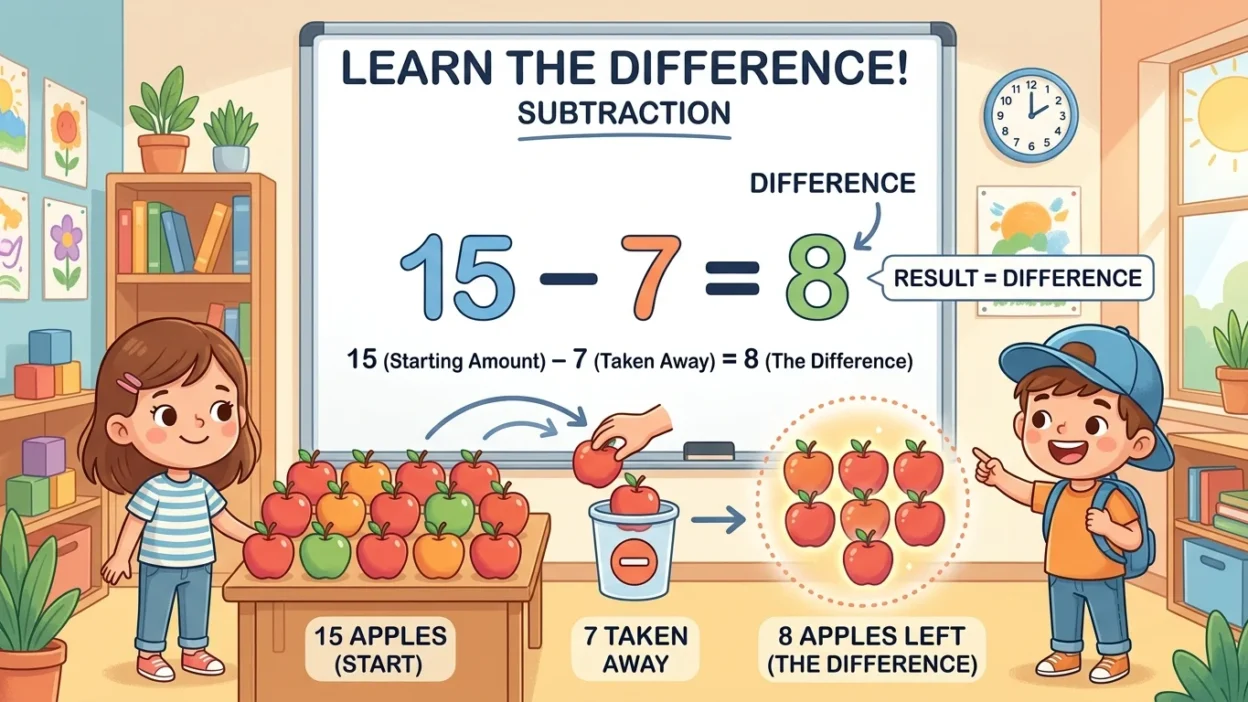
Have you ever been doing math homework and seen the word “difference” and felt a little confused? Maybe a teacher said, “Find the difference,” or you saw it in a word problem and weren’t sure what to do next. Many students first notice this word when learning subtraction, and it can feel a bit tricky at the beginning.
The good news is that once you understand it, it becomes one of the easiest and most useful ideas in math. You’ll see it again and again in school, exams, and even in real life when comparing numbers, prices, or scores. Let’s break it down in a simple way so it finally makes sense.
Quick Answer
In math, the “difference” means the result you get when you subtract one number from another.
What Does “Difference” Mean in Math?
In math, the word difference is another way of talking about subtraction.
When you subtract two numbers, the answer you get is called the difference.
For example:
- 10 − 4 = 6
So, 6 is the difference
We use the word “difference” because we are finding how far apart two numbers are or how much one number is bigger or smaller than another.
Simple Explanation
The difference tells us how much one number changes when taken away from another number.
Why People Use It
People use the word “difference” because it sounds more natural in word problems. Instead of always saying “subtract,” math questions often say:
- “Find the difference”
- “What is the difference between…?”
Example Sentence
- The difference between 15 and 9 is 6.
Bold Summary: In math, difference means the answer you get after subtracting one number from another.
Where Is “Difference” Used in Math?
The word difference meaning in math appears in many places, especially in school and everyday problem-solving.
You will often see it in:
1. School Word Problems
Teachers use it in questions like:
- “Find the difference between 20 and 12.”
2. Textbooks and Exams
It is a common keyword in instructions:
- “Calculate the difference.”
3. Real-Life Situations
We use difference when:
- Comparing prices in shopping
- Checking score differences in games
- Measuring height or weight changes
4. Everyday Conversations
Even outside math class, people say:
- “What’s the difference between these two options?”
Tone of Usage
The tone is usually neutral and formal in school, but casual in everyday talk.
7–10 Real-Life Conversation Examples (Math Context)
Here are simple, modern-style chat examples showing how “difference” is used in math situations:
student: what is the difference between 18 and 7?
friend: it’s 11, just subtract 7 from 18
teacher: find the difference between 50 and 23
student: 27
student: i got 40 and my friend got 55, what’s the difference?
friend: 15 points higher for your friend
student: how do i find the difference in this question?
friend: just subtract the smaller number from the bigger one
teacher: the difference between 100 and 60 is?
class: 40
student: i don’t get this difference question
friend: think of it like “how far apart are the numbers”
student: what’s the difference between 9 and 3
friend: 6, because 9 − 3 = 6
student: why do they say difference instead of subtract?
friend: it’s just another word for subtraction answer
student: the score difference is huge
friend: yeah, they are 20 points apart
student: can you check my answer for difference?
friend: sure, let’s see if your subtraction is right
When to Use and When Not to Use “Difference”
Understanding when to use the word difference meaning in math is important for writing correct answers and understanding questions.
✔️ When to Use It
- When subtracting two numbers
- When comparing values
- When solving word problems
- When asked “find the difference”
❌ When Not to Use It
- When adding numbers
- When multiplying or dividing
- When describing unrelated situations
- When no comparison is needed
Comparison Table
| Context | Example Phrase | Why It Works / Doesn’t Work |
|---|---|---|
| Subtraction | “Find the difference between 10 and 4” | Correct because it involves subtraction |
| Addition | “Find the difference of 5 + 3” | Incorrect because addition is not difference |
| Comparison | “Difference between prices is $20” | Correct because it compares values |
| Multiplication | “Difference of 6 × 2” | Incorrect because multiplication is not difference |
Similar Words or Alternatives in Math
Here are some related words you may also see in math:
1. Subtraction
This is the process of taking one number away from another.
Example: 9 − 3 = 6
2. Minus
A simple way to say subtraction in everyday language.
Example: 10 minus 2 equals 8
3. Decrease
Used when a number becomes smaller.
Example: The price decreased by 5
4. Gap
Sometimes used instead of difference in casual speech.
Example: The gap between scores is large
5. Change
Used in real-life problems involving increase or decrease.
Example: The change in temperature is 3 degrees
Each of these words connects to the idea of comparing numbers, but difference is the most common in school math.
FAQs About Difference Meaning in Math
1. What does difference mean in simple words?
It means the result you get when you subtract one number from another.
2. Is difference always subtraction?
Yes, in math, difference always comes from subtraction.
3. Why do teachers use the word difference?
Because it makes word problems sound more natural and helps students understand comparison.
4. Is difference only used in math?
No, it is also used in daily life to compare things like prices, scores, or sizes.
5. What is the difference between 8 and 3?
The answer is 5 because 8 − 3 = 5.
6. Is difference positive or negative?
Usually positive, but it can be negative if you subtract a larger number from a smaller one.
7. What grade learns difference in math?
Students usually learn it in early primary grades when they start subtraction.
Final Thought
The difference meaning in math is very simple once you understand it: it is just the answer you get after subtracting one number from another. It helps us compare values, understand gaps, and solve everyday problems more easily. From school worksheets to real-life situations like shopping or scoring games, the idea of difference is everywhere. Once you master it, subtraction questions become much faster and clearer to solve, making math feel less confusing and more useful in daily life.