
What It Means, Symptoms, and Why People Talk About It
Have you ever looked at an MRI report, medical note, or health discussion online and come across the phrase “disc desiccation”? It can sound confusing and even a little scary at first. Many people discover the term after a doctor visit or while searching for answers about back pain. You might see it mentioned in online health forums, social media discussions, or messages from friends talking about spine problems.
The good news is that disc desiccation is a common medical finding, especially as people get older. Understanding what it means can help you feel more informed and less worried. In this guide, we’ll explain disc desiccation meaning in simple language, where the term is commonly used, and what it may mean for your spine health.
Quick Answer
Disc desiccation means that a spinal disc has lost some of its normal water content, often as part of the natural aging process.
What Does Disc Desiccation Mean?
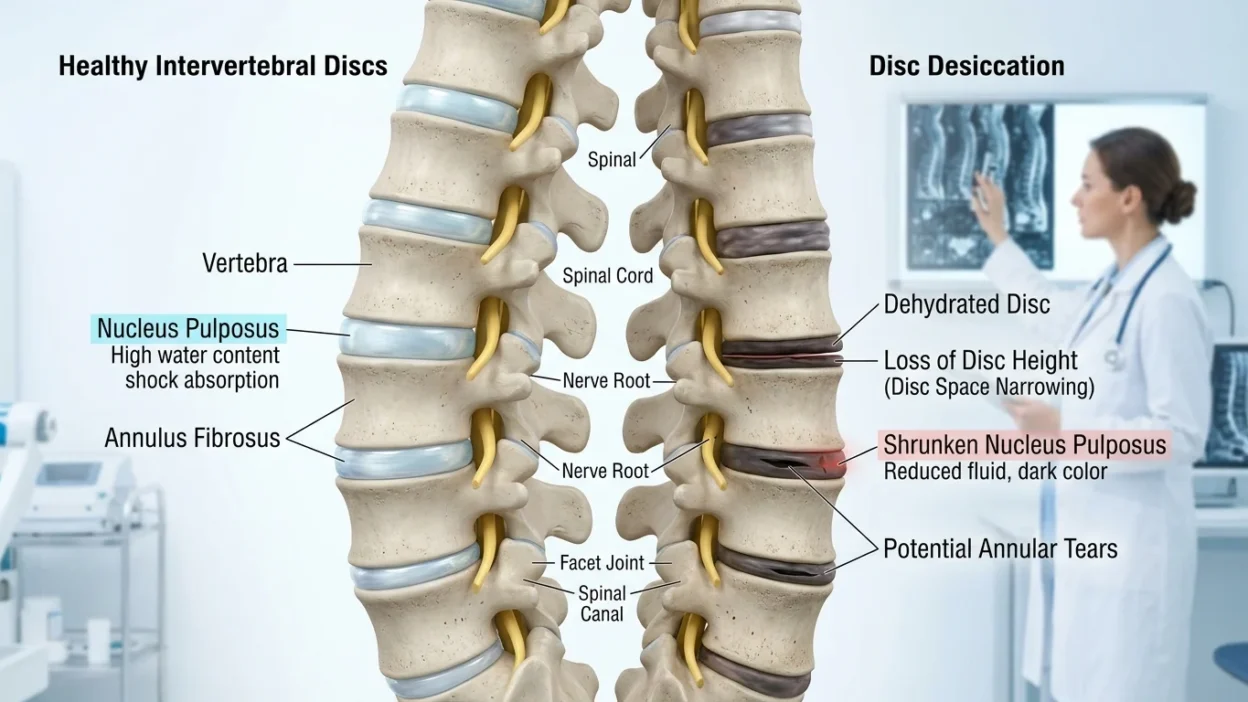
The term disc desiccation is a medical phrase used to describe the drying out of one or more discs in the spine.
Breaking Down the Term
- Disc: The soft cushion located between the bones (vertebrae) in your spine.
- Desiccation: A medical word that means drying out or losing moisture.
When combined, disc desiccation simply means that a spinal disc has lost some of the water it normally contains.
Plain-English Explanation
Healthy spinal discs contain a large amount of water. This water helps the discs stay flexible, absorb shock, and support movement. Over time, discs naturally lose some of this moisture. As they become drier, they may not cushion the spine as effectively as they once did.
This process is very common and often happens with age.
Why Do People Use This Term?
Doctors, radiologists, and healthcare professionals use the phrase when reviewing MRI scans and spinal imaging results. It helps describe changes seen inside the spine.
Example Sentence
“The MRI showed mild disc desiccation in the lower back, but no serious nerve compression.”
Summary: Disc desiccation means a spinal disc has lost some of its natural water content, usually due to aging or wear and tear.
Where Is the Term Commonly Used?
Unlike internet slang or texting abbreviations, disc desiccation is primarily a medical term.
You may see it in:
- MRI reports
- Medical records
- Doctor consultations
- Physical therapy discussions
- Health forums
- Online medical articles
- Social media health communities
- Patient support groups
Tone of the Term
| Setting | Tone |
|---|---|
| Medical reports | Formal |
| Doctor discussions | Professional |
| Health forums | Neutral |
| Social media health groups | Informal to neutral |
| Patient conversations | Casual |
Because it is a medical phrase, it is not typically used as chat shorthand, texting slang, or social media slang.
Common Causes of Disc Desiccation
Disc desiccation can happen for several reasons.
1. Natural Aging
The most common cause is aging. As people get older, spinal discs gradually lose water.
2. Repeated Stress
Activities that place ongoing stress on the spine may contribute to disc wear over time.
Examples include:
- Heavy lifting
- Repetitive bending
- Physical labor
- High-impact sports
3. Injury
A back injury can sometimes speed up disc degeneration and moisture loss.
4. Genetics
Some people are more likely to experience spinal disc changes because of inherited factors.
5. Poor Posture
Long periods of poor posture may increase stress on spinal structures and contribute to disc problems.
Symptoms Associated With Disc Desiccation
Not everyone with disc desiccation experiences symptoms.
In many cases, people only discover it after having an MRI for another reason.
However, symptoms may include:
- Lower back pain
- Neck pain
- Stiffness
- Reduced flexibility
- Pain during movement
- Discomfort after sitting for long periods
If nearby nerves become affected, additional symptoms may occur, such as:
- Numbness
- Tingling
- Weakness in arms or legs
Realistic Conversation Examples
Below are examples of how people might naturally discuss disc desiccation online or in everyday conversations.
- “my mri report says i have disc desiccation. should i be worried?”
- “the doctor told me the disc desiccation is mild and pretty common.”
- “i started physical therapy after learning about my disc desiccation.”
- “has anyone else experienced lower back pain from disc desiccation?”
- “my scan showed disc desiccation but no major spinal damage.”
- “the specialist explained that disc desiccation often happens with age.”
- “i was nervous when i saw the term disc desiccation on the report.”
- “exercise and stretching seem to help my symptoms.”
- “the radiologist noted mild disc desiccation at two levels.”
- “i found a support group online where people share experiences about disc desiccation.”
When to Use and When Not to Use the Term
Understanding the correct context helps prevent confusion.
Do Use It When
✅ Discussing MRI findings
✅ Talking with healthcare professionals
✅ Reading medical records
✅ Participating in health forums
✅ Researching spinal conditions
Don’t Use It When
❌ Referring to general back pain without a diagnosis
❌ Using casual slang in text messages
❌ Describing muscle soreness
❌ Replacing a doctor’s diagnosis
❌ Discussing unrelated injuries
Context Comparison Table
| Context | Example Phrase | Why It Works or Doesn’t Work |
|---|---|---|
| MRI discussion | “the report mentions disc desiccation” | Correct medical usage |
| Doctor appointment | “can you explain my disc desiccation?” | Appropriate context |
| Casual texting | “i’m tired because of disc desiccation lol” | Usually not a natural use |
| Fitness discussion | “my doctor linked the pain to disc desiccation” | Relevant and accurate |
| Random chat | “that’s so disc desiccation” | Incorrect usage |
Similar Medical Terms and Alternatives
People often encounter related terms while researching spine health.
| Term | Meaning | When Used |
|---|---|---|
| Disc degeneration | Breakdown of a spinal disc over time | Common in MRI reports |
| Degenerative disc disease | Age-related disc changes that may cause symptoms | Medical diagnosis |
| Bulging disc | Disc extends beyond its normal boundary | Imaging reports |
| Herniated disc | Disc material pushes outward | Spine conditions |
| Spinal degeneration | General wear and tear of the spine | Medical discussions |
| Disc dehydration | Simpler way of describing moisture loss | Patient education |
| Disc wear and tear | Everyday language explanation | Casual conversations |
Disc Desiccation vs Disc Degeneration
Many people confuse these terms.
- Disc desiccation specifically refers to moisture loss.
- Disc degeneration is a broader term that includes several structural changes in the disc.
In other words, disc desiccation can be one part of disc degeneration.
Can Disc Desiccation Be Treated?
Treatment depends on symptoms rather than the MRI finding itself.
Common management approaches may include:
- Physical therapy
- Exercise programs
- Posture improvement
- Weight management
- Stretching routines
- Pain management strategies
- Activity modification
In severe cases involving nerve compression or significant pain, doctors may discuss additional treatment options.
Always consult a qualified healthcare professional for personal medical advice.
Frequently Asked Questions (FAQ)
1. Is disc desiccation serious?
Not always. Many people have mild disc desiccation without major symptoms. The seriousness depends on the overall condition of the spine and any related problems.
2. Is disc desiccation a normal part of aging?
Yes. Disc moisture naturally decreases with age, making disc desiccation a common finding in adults.
3. Can disc desiccation cause back pain?
It can contribute to back pain in some people, but not everyone experiences symptoms.
4. Can exercise help with disc desiccation?
Many people benefit from doctor-approved exercise and physical therapy programs that improve strength, flexibility, and spinal support.
5. Is disc desiccation the same as a herniated disc?
No. Disc desiccation refers to moisture loss, while a herniated disc involves disc material pushing outward.
6. Can young people have disc desiccation?
Yes. Although more common with aging, younger individuals can experience it due to injury, genetics, or repeated stress on the spine.
7. Is disc desiccation a texting abbreviation or online chat slang?
No. Disc desiccation is a medical term, not a texting abbreviation, social media slang expression, or chat shorthand.
Final Thought
Understanding disc desiccation meaning is important if you’ve seen the term in an MRI report, doctor’s note, or online health discussion. In simple terms, it refers to the loss of water within a spinal disc, which commonly happens as part of the aging process. While the phrase may sound alarming at first, it is often a normal finding and does not always cause symptoms. Knowing what disc desiccation means can help you have better conversations with healthcare providers, understand your medical reports, and make informed decisions about your spinal health.