Have you ever been reading a sentence like “This gift is for you” or “I waited for two hours” and suddenly paused, thinking, why is “for” used here and what does it really mean?
\Many learners first notice the word “for” in chats, textbooks, or social media captions and assume it has only one fixed meaning. But then it appears in different situations, and things start to feel confusing. Is it about time? Purpose? Reason? Or something else?
This small word shows up everywhere in English, from daily conversations to formal writing, making it one of the most important words to understand clearly.
Quick Answer:
The word “for” in English grammar is a preposition used to show purpose, reason, duration, benefit, or direction toward someone or something.
Meaning of “For” in English Grammar (Simple Explanation)
In English grammar, “for” is a preposition. That means it is a linking word that connects ideas in a sentence.
Full Understanding of “For”
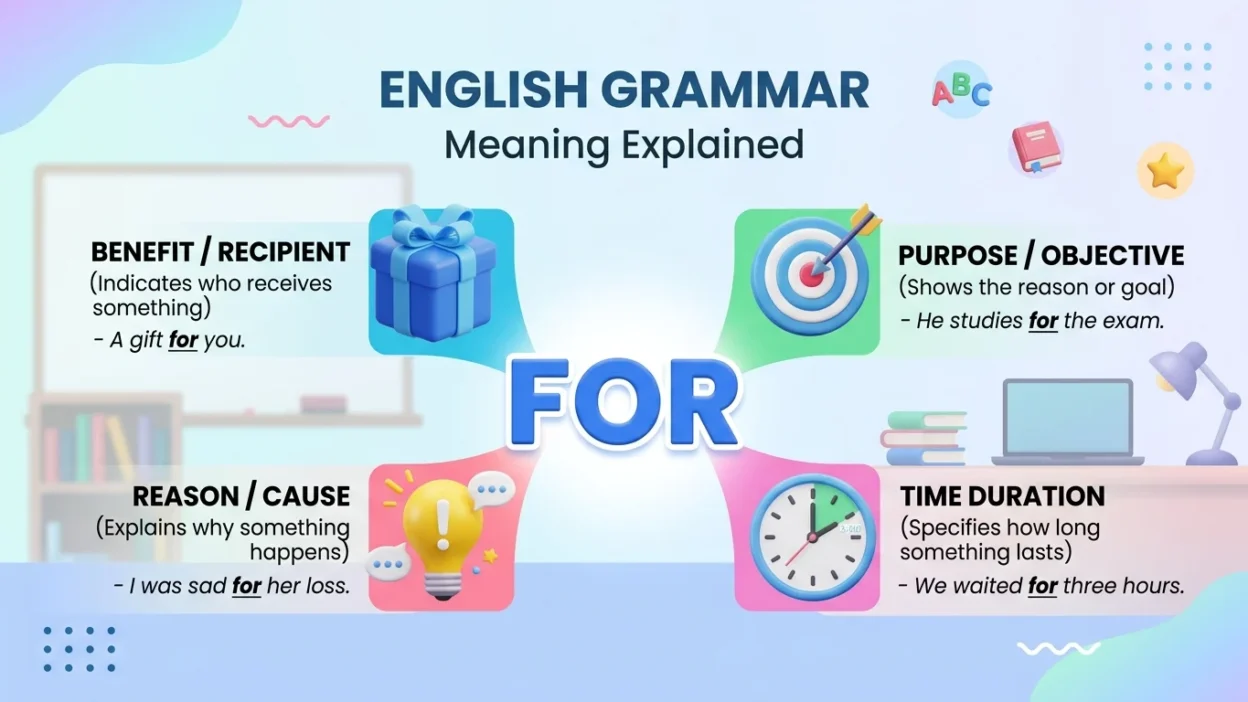
The word “for” does not have a single fixed meaning. Instead, it changes based on context. It can show:
- Purpose → I bought flowers for my mother.
- Benefit → This gift is for you.
- Duration → I studied for three hours.
- Reason → She was punished for being late.
So, “for” is flexible and helps explain why, how long, or for whom something happens.
People use it because it makes sentences clear and meaningful without repeating extra words.
Simple Example Sentence:
- I made this cake for my friend.
Bold Summary: “For” is a preposition used to show purpose, reason, duration, or benefit in a sentence.
Where “For” Is Commonly Used in English
The word “for” is used in almost every type of communication, whether formal or informal.
1. Daily Conversation
People use it while speaking to explain reasons or purposes:
- I went out for dinner.
- This is for my brother.
2. Texting and Social Media
In informal chats, “for” is often used in short messages:
- this is for you
- waiting for you
- doing this for fun
Tone here is usually casual and informal.
3. School and Academic Writing
Students use it in essays and explanations:
- The experiment was conducted for research purposes.
Tone here is formal and structured.
4. Professional Communication
Used in emails, reports, and office messages:
- This document is for your review.
Tone here is formal and polite.
5. Gaming and Online Chats
Players use it in quick messages:
- this match is for fun
- i saved this item for you
Tone is informal and fast-paced.
Real-Life Conversation Examples (Text Style)
Here are natural texting-style examples showing how people actually use “for” online:
- i saved this for you
- waiting for my food lol
- this meme is for you 😂
- doing this for fun not work
- i was late for class today
- thanks for helping me out
- this gift is for my sister
- i trained for two hours
- she left for home already
- this song is for you vibes
These examples reflect real text slang meaning and informal chat usage in modern digital communication.
When to Use and When Not to Use “For”
Understanding when to use “for” correctly helps you avoid grammar mistakes.
✅ When to Use “For”
- To show purpose: I study for exams
- To show benefit: This is for you
- To show duration: I waited for an hour
- To show reason: He was fined for speeding
❌ When NOT to Use “For”
- Don’t use it when “to” is needed for direction
- Don’t overuse it in one sentence
- Avoid it when another preposition fits better
Comparison Table
| Context | Example Phrase | Why It Works / Doesn’t Work |
|---|---|---|
| Purpose | I bought this for you | Correct use showing benefit |
| Duration | I stayed for 5 hours | Correct use showing time |
| Direction | I go for school ❌ | Wrong, should be “to school” |
| Reason | He was punished for lying | Correct use showing reason |
Similar Words and Alternatives for “For”
English has several words and phrases that can sometimes replace “for,” depending on meaning.
1. To
Used for direction or destination:
- I am going to school.
2. Because of
Used for reasons:
- The match was canceled because of rain.
3. On behalf of
Used in formal speaking:
- I am speaking on behalf of my team.
4. In order to
Used to show purpose:
- I study hard in order to pass exams.
5. For the sake of
Used for strong purpose or benefit:
- She stayed for the sake of her family.
Each alternative depends on the situation, but “for” remains the simplest and most commonly used.
Common Mistakes Learners Make with “For”
Many English learners get confused with this word because it has multiple meanings.
Mistake 1: Using “for” instead of “to”
- ❌ I am going for school
- ✅ I am going to school
Mistake 2: Confusing reason and purpose
- ❌ I study for I want success
- ✅ I study because I want success
Mistake 3: Overusing in sentences
- ❌ I went for for for shopping
- ✅ I went shopping
Learning the correct structure helps you sound more natural in English.
FAQs About “For Meaning in English Grammar”
1. What does “for” mean in simple English grammar?
“For” is a preposition used to show purpose, reason, duration, or benefit in a sentence.
2. Is “for” formal or informal?
It is neutral. It can be used in both formal writing and informal chatting depending on the sentence.
3. Can “for” be used in texting?
Yes, “for” is very common in texting and social media chats like “this is for you” or “waiting for you.”
4. What type of word is “for” in grammar?
It is a preposition, meaning it connects nouns, pronouns, and phrases.
5. Why is “for” important in English?
Because it helps express purpose, reason, and time clearly in both spoken and written English.
6. Is “for” the same as “because”?
No. “For” shows reason in a general sense, while “because” gives a direct cause.
7. Can beginners easily learn “for” usage?
Yes. It is simple once you understand its main uses like purpose, benefit, and duration.
Final Thought
The word “for” may look small, but it plays a powerful role in English grammar. It helps connect ideas, explain reasons, show purpose, and describe time or benefit. Whether you’re writing a formal essay, sending a quick text, or chatting online, “for” makes your meaning clearer and more natural. Once you understand its different uses, you’ll start noticing it everywhere in everyday English communication.
Mastering simple words like “for” is a big step toward speaking and writing English more confidently and naturally in modern digital communication.