
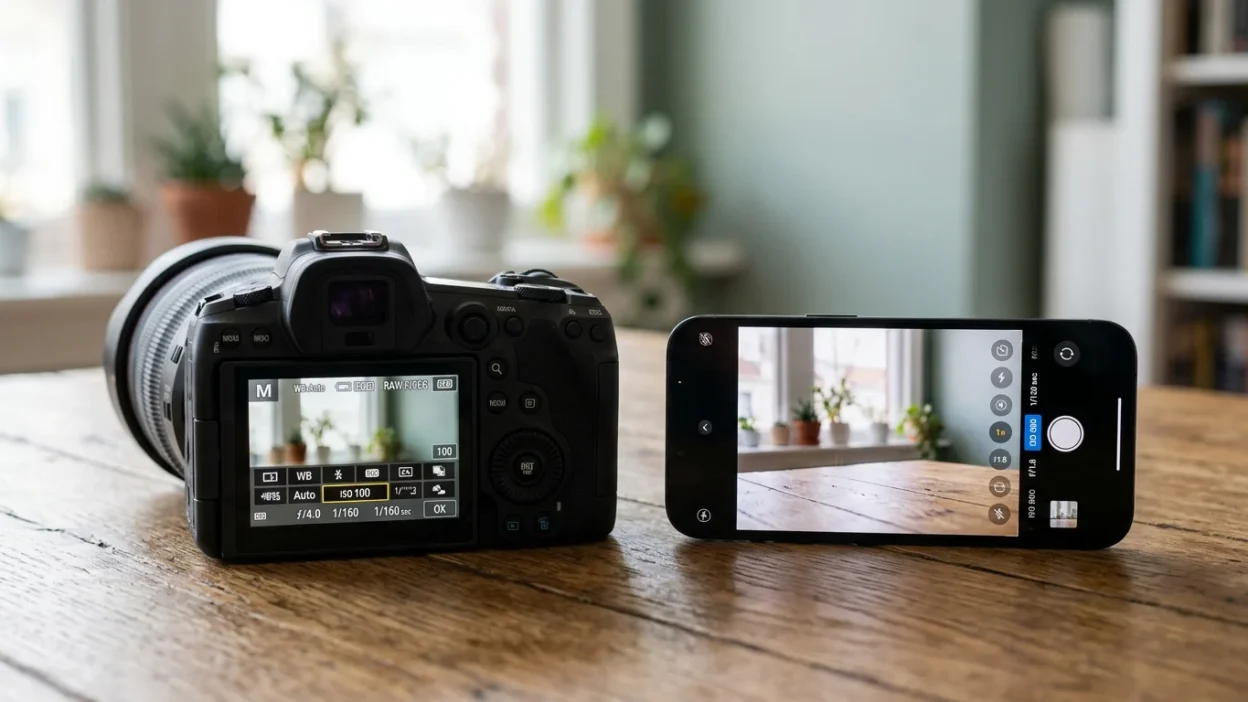
Have you ever opened a camera app or watched a photography tutorial and heard someone say “increase the ISO” or “set ISO to 200” and felt completely lost? Maybe you saw it in a YouTube comment or a reel where a creator was talking about getting brighter photos in low light.
At first, it sounds super technical and confusing, like something only professionals understand. But once you break it down, ISO is actually one of the easiest camera settings to understand. And the best part? It can instantly improve your photos once you know how it works.
In this article, we’ll explain ISO in the simplest way possible so you can confidently use it in your camera or phone settings.
Quick Answer: ISO in camera means the sensitivity of your camera’s sensor to light.
What Does ISO Mean in Camera? (Full Explanation)
In photography, ISO stands for International Organization for Standardization, but don’t worry about the long name. In cameras, ISO simply refers to how sensitive your camera sensor is to light.
Think of it like this:
- Low ISO = less sensitive to light (darker image, but cleaner quality)
- High ISO = more sensitive to light (brighter image, but may add grain or noise)
So, when you increase ISO, your camera becomes better at capturing light in dark places. When you lower it, your photo stays sharp and clean in bright environments.
Simple Example:
If you take a photo outside on a sunny day, you might use ISO 100.
If you take a photo at night indoors, you might increase it to ISO 800 or higher.
Bold Summary: ISO is a camera setting that controls how bright or dark your photo appears by adjusting light sensitivity.
Why ISO Is Important in Photography
ISO plays a big role in getting the perfect photo because light is everything in photography. Without the right ISO, your pictures can look too dark or too grainy.
Here’s why people use ISO:
- To adjust brightness in different lighting conditions
- To avoid blurry photos in low light
- To balance shutter speed and aperture
- To improve overall image quality
Most modern cameras and smartphones automatically adjust ISO, but learning it manually gives you more control over your shots.
Where ISO Is Commonly Used
You’ll find ISO settings in almost every camera-related situation, such as:
- Smartphone camera pro mode
- DSLR and mirrorless cameras
- Photography apps
- Video recording settings
- YouTube content creation
- Social media photography (Instagram, TikTok, etc.)
The tone around ISO in photography is usually technical but beginner-friendly, especially in online tutorials. It’s not slang or informal chat language—it’s a formal photography term used by creators, professionals, and hobbyists.
Real-Life Texting & Chat Examples (Casual Style)
Even though ISO is a technical term, people often talk about it casually in chats when discussing photos or camera settings.
Here are some natural examples:
- “bro increase iso a bit, the pic is too dark”
- “i shot this at iso 100, looks super clean”
- “don’t go too high on iso or it’ll get grainy”
- “what iso setting did you use for this night shot?”
- “try iso 800 in low light, it helps a lot”
- “my phone auto raised iso and the pic got noisy lol”
- “keep iso low if you want sharp photos”
- “iso and shutter speed balance is tricky at first”
- “i forgot to adjust iso, that’s why it’s blurry”
- “this camera handles high iso really well tbh”
These examples show how ISO is discussed in a relaxed, everyday digital conversation style.
When to Use ISO and When Not to Use It
Understanding when to adjust ISO can make a huge difference in your photography.
✅ When to Use Higher ISO:
- Low-light environments (night, indoors, concerts)
- When you need brighter images quickly
- When using faster shutter speed
❌ When Not to Use High ISO:
- Bright sunlight (image will get overexposed)
- When you want very clean, sharp photos
- When your camera already has enough light
Comparison Table:
| Context | Example Setting | Why It Works / Doesn’t Work |
|---|---|---|
| Sunny outdoor photo | ISO 100 | Keeps image clean and sharp |
| Night street photo | ISO 800 | Adds brightness in low light |
| Indoor dim room | ISO 1600 | Helps capture visible details |
| Bright studio lighting | ISO 200 | Prevents overexposure |
Using ISO correctly helps you control the balance between brightness and image quality.
Common ISO Alternatives or Related Terms
To fully understand ISO, it helps to know other related photography terms:
1. Shutter Speed
Controls how long your camera captures light.
- Fast shutter = sharp images
- Slow shutter = motion blur
2. Aperture
Controls how much light enters through the lens.
- Wide aperture = more light and blur background
- Narrow aperture = less light and sharper focus
3. Exposure
Overall brightness of the photo. ISO, shutter speed, and aperture all work together to control it.
4. Gain (Video ISO equivalent)
Used in video recording to adjust brightness digitally.
5. Auto ISO
A feature where the camera automatically adjusts ISO for you.
These terms are often used together in photography tutorials and editing guides.
ISO in Social Media Photography Culture
On platforms like Instagram, TikTok, and YouTube, ISO is often mentioned in editing tips, camera settings breakdowns, and “how I shot this” videos.
For example:
- Travel vloggers use ISO to capture night city scenes
- Food photographers adjust ISO for clean lighting
- Mobile photographers rely on auto ISO for quick shots
Even though it’s a technical term, it has become part of modern social media photography slang culture, especially among creators.
FAQ About ISO Meaning Camera
1. What does ISO mean in a camera?
ISO means how sensitive your camera is to light. It controls how bright or dark your photo looks.
2. Is higher ISO better?
Not always. Higher ISO helps in low light but can make photos grainy.
3. What ISO should I use for beginners?
Start with ISO 100–200 in daylight and increase it only in darker settings.
4. Does ISO affect photo quality?
Yes, higher ISO can reduce image quality by adding noise or grain.
5. Is ISO automatic in phones?
Most smartphones use auto ISO, but some have manual “pro mode” settings.
6. Can ISO fix blurry photos?
No, ISO only affects brightness, not motion blur or focus.
7. Is ISO the same as brightness?
Not exactly. ISO affects sensitivity to light, which indirectly changes brightness.
Final Thought
ISO might sound like a complicated photography term, but it’s actually one of the simplest tools to understand once you break it down. It helps you control how bright your photos are by adjusting how sensitive your camera is to light. Whether you’re taking selfies, night shots, or travel photos, knowing how to use ISO gives you more control and better results. In today’s digital world, where everyone shares photos online, learning ISO can instantly upgrade your photography game—even if you’re just using a smartphone.