Have you ever been scrolling through social media, reading sports news, or following a court case online when you saw the word “overturned” and wondered what it meant? Maybe someone posted, “The decision was overturned,” or a sports fan wrote, “The referee’s call got overturned after review.” If you’re not familiar with the term, it can sound confusing at first.
The good news is that overturned is actually a simple word once you understand the context. It is commonly used in legal discussions, sports, news reports, and everyday conversations. In this guide, you’ll learn the exact overturned meaning, where it’s used, how to use it correctly, and examples that make it easy to understand.
Quick Answer:
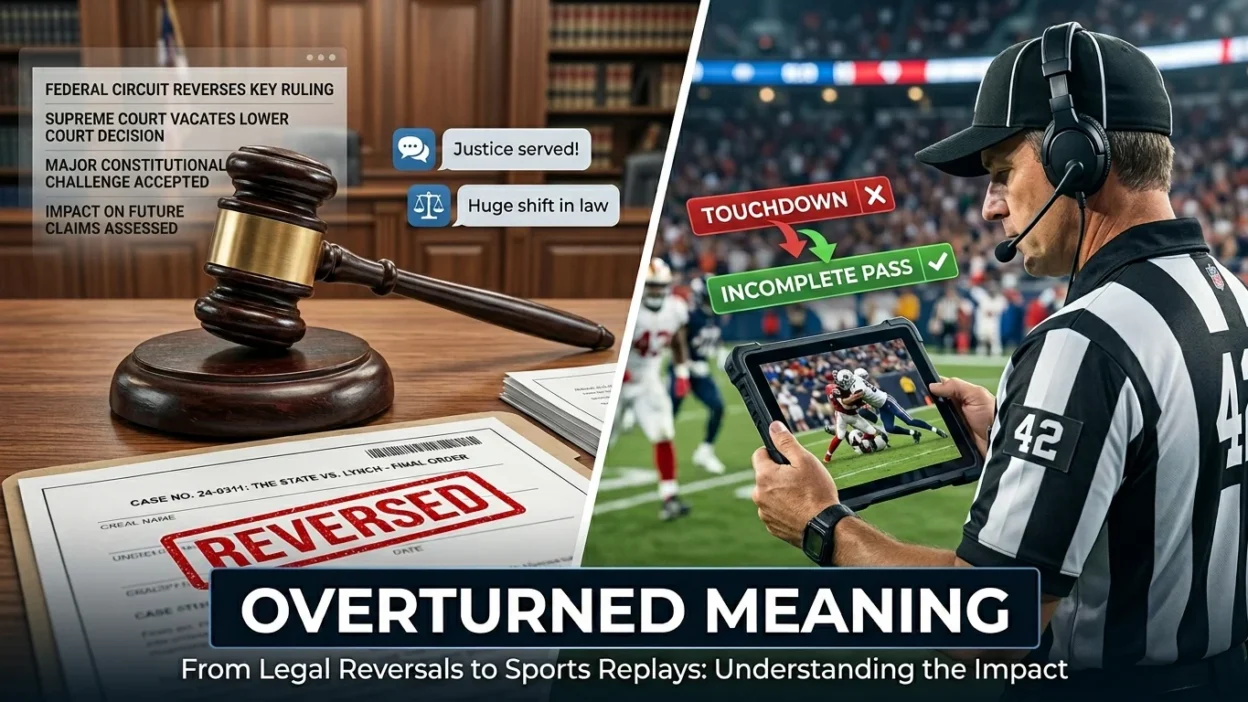
Overturned means that a decision, ruling, judgment, or result has been changed, canceled, or reversed by someone with authority.
Overturned Meaning in Text
The word overturned is the past tense of overturn.
Plain-English Explanation
When something is overturned, it means that an earlier decision or action is no longer accepted because a new decision has replaced it.
Think of it this way:
- A judge makes a decision.
- A higher court reviews it.
- The higher court changes or cancels that decision.
- The original decision is overturned.
The same idea applies in sports, business, school rules, and other situations where decisions can be reviewed and changed.
Why People Use It
People use overturned when talking about:
- Court rulings
- Sports reviews
- Government decisions
- School policies
- Company decisions
- Online discussions about major events
Example Sentence
“The referee reviewed the video and overturned the original call.”
Summary: Overturned means a previous decision, ruling, or result has been officially reversed or changed.
Where Is the Term Overturned Commonly Used?
Unlike many social media slang terms, overturned is a standard English word used in both formal and informal communication.
Legal Settings
One of the most common uses is in law.
Example:
- “The court overturned the conviction.”
This means the court reversed an earlier legal decision.
Sports
Sports fans often hear this term during video reviews.
Example:
- “The touchdown was overturned after replay review.”
News Reports
Journalists frequently use the word when discussing politics, laws, and court cases.
Example:
- “The ruling was overturned by a higher court.”
Social Media
People use it when discussing news stories, sports events, or controversial decisions.
Example:
- “wow, i can’t believe that decision got overturned.”
Online Forums and Comments
The term often appears in discussions about rules, moderation decisions, or official actions.
Tone of the Word
| Situation | Tone |
|---|---|
| Court cases | Formal |
| News articles | Formal |
| Sports discussions | Neutral |
| Social media comments | Neutral to casual |
| Group chats | Casual |
Overall, overturned is usually considered a neutral word. It works in both professional and everyday conversations.
Conversation Examples Using Overturned
Here are realistic examples showing how people use the term in modern chats and online conversations.
Example 1
friend 1: did you watch the game last night?
friend 2: yeah, the final call got overturned after replay.
Example 2
user 1: what happened in the court case?
user 2: the original ruling was overturned.
Example 3
friend 1: i thought they won.
friend 2: they did at first, but the result was overturned later.
Example 4
user 1: why is everyone talking about the news?
user 2: because the law was overturned yesterday.
Example 5
friend 1: did the referee make a mistake?
friend 2: apparently, that’s why the call was overturned.
Example 6
user 1: what does overturned mean?
user 2: it means a previous decision got reversed.
Example 7
friend 1: the school changed its policy?
friend 2: yep, the old rule was overturned.
Example 8
user 1: i saw “overturned” in the article.
user 2: it means the earlier decision was canceled or changed.
Example 9
friend 1: was the ban removed?
friend 2: basically, yes. the decision was overturned.
When to Use and When Not to Use Overturned
Knowing the right context helps you sound natural and accurate.
Use Overturned When
✅ A decision has been reversed
✅ A court ruling has changed
✅ A sports call has been reviewed and reversed
✅ A policy or rule has been canceled
✅ An official judgment has been replaced
Don’t Use Overturned When
❌ Talking about simple opinions
❌ Discussing everyday preferences
❌ Referring to casual disagreements
❌ Describing personal feelings
❌ Talking about something that was never officially decided
Comparison Table
| Context | Example Phrase | Why It Works |
|---|---|---|
| Court ruling | “The verdict was overturned.” | Official decision reversed |
| Sports review | “The call was overturned.” | Review changed the decision |
| Company policy | “The policy was overturned.” | Rule officially changed |
| Personal opinion | “My favorite color was overturned.” | Doesn’t make sense |
| Casual preference | “My lunch choice was overturned.” | Not an official ruling |
Similar Words and Alternatives
Several words have meanings close to overturned, but each has slightly different usage.
| Word | Meaning | Best Used When |
|---|---|---|
| Reversed | Changed to the opposite decision | Courts, sports, reviews |
| Canceled | Officially stopped | Events, plans, policies |
| Revoked | Taken away officially | Licenses, permissions |
| Annulled | Declared invalid | Legal or formal situations |
| Changed | Made different | General situations |
| Withdrawn | Taken back | Statements, offers, rules |
| Invalidated | Declared not valid | Legal and technical contexts |
| Rejected | Not accepted | Applications, proposals |
Reversed
This is probably the closest alternative.
Example:
“The ruling was reversed.”
Revoked
Often used when permission or authority is removed.
Example:
“His license was revoked.”
Annulled
Usually appears in legal settings.
Example:
“The agreement was annulled.”
Invalidated
Means something has been declared legally or officially incorrect.
Example:
“The court invalidated the law.”
Why Overturned Is Important to Understand
The word appears frequently in:
- Breaking news
- Sports coverage
- Legal discussions
- Political debates
- Social media posts
- Online articles
If you understand overturned meaning, you’ll have a much easier time following important stories and discussions online.
The term often signals that something significant has changed. That’s why headlines frequently use it to grab attention.
For example:
- “Court Overturns Earlier Decision”
- “Referee Overturns Game-Changing Call”
- “Policy Overturned After Review”
In each case, the key idea is the same: an earlier decision was reversed by someone with authority.
Frequently Asked Questions (FAQ)
What does overturned mean?
Overturned means a previous decision, ruling, judgment, or result has been officially reversed, canceled, or changed.
Is overturned a slang word?
No. Overturned is a standard English word, not social media slang or a texting abbreviation.
Is overturned formal or informal?
It is generally a neutral word that works in both formal and informal situations.
Why do people use overturned in sports?
Sports officials often review plays using video replay. If the review changes the original decision, the call is said to be overturned.
What does overturned mean in law?
In legal settings, it means a higher court has reversed a previous court decision or judgment.
Is overturned common on social media?
Yes. People frequently use it when discussing news stories, court cases, sports events, and political decisions.
Can overturned mean physically turned over?
Yes. In some contexts, it can mean something literally flipped over.
Example:
“The truck overturned on the highway.”
However, in most news and discussion contexts, it refers to a reversed decision rather than a physical object.
Final Thought
Understanding overturned meaning is useful because the word appears everywhere—from legal news and sports highlights to social media discussions and online forums. In simple terms, overturned means that an earlier decision, ruling, or result has been officially reversed or changed by someone with authority. Whether you’re reading headlines, watching a game, or following an important court case, knowing this term helps you quickly understand what happened and why it matters. As digital communication continues to connect people with news and events in real time, recognizing words like overturned makes it easier to stay informed and join conversations with confidence.