Have you ever been scrolling through messages, gaming chats, or social media comments and suddenly noticed someone say “TTS”? If you are new to online slang, it can be confusing at first. Many people see this abbreviation in text conversations and wonder if it is a joke,
a gaming term, or some kind of internet code. The truth is that TTS has a few meanings, but one is far more common than the others in digital communication. Understanding it can help you follow conversations more easily and avoid confusion when chatting online.
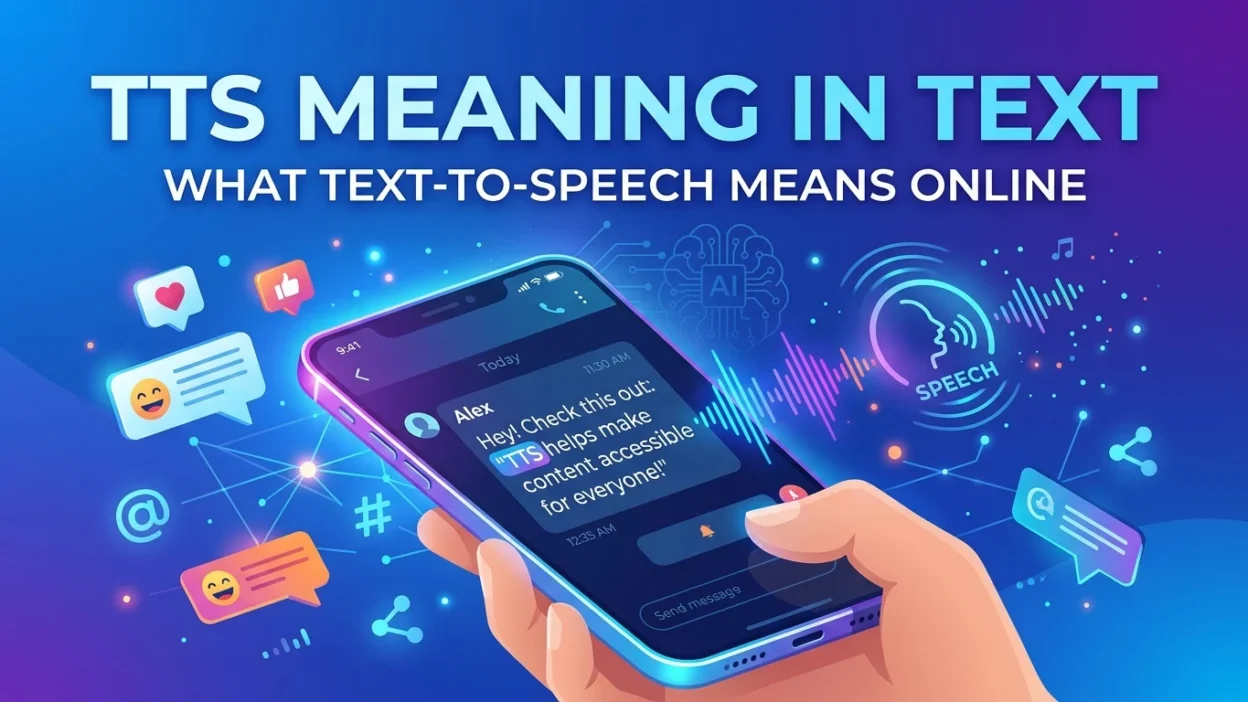
Quick Answer: TTS most commonly means “Text-to-Speech” in text, referring to technology that converts written words into spoken audio.
What Does TTS Mean in Text?
In most online conversations, TTS stands for “Text-to-Speech.” It is a technology that reads written text aloud using a computer-generated voice.
People often mention TTS when talking about accessibility tools, livestreams, gaming platforms, apps, or content creation. In some online communities, viewers can send messages that are automatically read aloud through a text-to-speech system.
For example:
“your donation triggered the tts message on the stream.”
In simple terms, TTS takes words that are typed on a screen and turns them into spoken words.
Why Do People Use TTS?
People use TTS for several reasons:
- To help users with visual impairments.
- To listen to text instead of reading it.
- To make livestreams more interactive.
- To create voiceovers for videos.
- To improve accessibility in apps and websites.
Example Sentence
“i turned on tts so i could listen to the article while driving.”
Summary: TTS means “Text-to-Speech,” a tool that converts written text into spoken audio.
Where Is TTS Commonly Used?
TTS appears in many digital spaces and online communities. While it is often discussed in technology-related conversations, it is also common in everyday texting and social media.
Texting and Messaging Apps
Friends may mention TTS when discussing accessibility features or voice-reading tools.
Example:
“use tts if you don’t feel like reading the whole thing.”
Social Media Platforms
Creators often use TTS voices in short-form videos because they are quick and easy to add.
Example:
“the video uses a tts voice instead of a real narrator.”
Livestreams
On streaming platforms, viewers may pay to have their messages read aloud through TTS systems.
Example:
“the streamer laughed when the tts message played.”
Gaming Chats
Gamers sometimes use TTS for communication or accessibility purposes.
Example:
“enable tts so team messages can be read aloud.”
Online Forums and Communities
People discussing software, accessibility tools, or content creation often mention TTS features.
Tone of TTS
Unlike many social media slang terms, TTS is usually neutral rather than emotional.
- Casual: Yes
- Informal: Yes
- Neutral: Most common
- Formal: Sometimes used in technical discussions
Because TTS describes a technology, it generally does not carry a positive or negative tone.
Realistic Conversation Examples
Here are some natural examples showing how people use TTS in modern chats.
Example 1
alex: did you hear that voice in the video?
sam: yeah, it’s tts
Example 2
jordan: who’s talking on the stream?
mia: nobody, it’s just tts
Example 3
liam: i don’t want to read all of that
emma: turn on tts and listen to it
Example 4
noah: how did they make the narration so fast?
olivia: they used tts software
Example 5
jack: what does tts mean?
ava: text-to-speech
Example 6
ryan: my phone started reading messages aloud
ella: sounds like you enabled tts
Example 7
leo: the donation message was hilarious
zoe: the tts voice made it even funnier
Example 8
ben: can this app read articles aloud?
lily: yes, it has built-in tts
Example 9
ethan: i use tts while studying
grace: same, it helps me focus
When to Use TTS and When Not to Use It
Understanding the right context helps you use the term correctly.
Use TTS When
✅ Talking about text-to-speech software
✅ Discussing accessibility tools
✅ Referring to voice-generated narration
✅ Talking about livestream messages being read aloud
✅ Discussing content creation tools
Do Not Use TTS When
❌ Trying to express emotions
❌ Replacing greetings or reactions
❌ Using it as a response to jokes
❌ Assuming everyone knows the abbreviation
❌ Using it in situations unrelated to text-to-speech
Quick Comparison Table
| Context | Example Phrase | Why It Works |
|---|---|---|
| Accessibility | “i use tts to read articles” | Refers to text-to-speech technology |
| Streaming | “the tts donation was funny” | Message was read aloud automatically |
| Content Creation | “this video uses tts narration” | Describes AI-generated speech |
| Greeting | “tts, how are you?” | Does not work because TTS is not a greeting |
| Reaction | “tts lol” | Usually unclear and confusing |
Similar Slang Words and Alternatives
Although TTS is more of a technical abbreviation than social media slang, several related terms appear in online chats.
| Term | Meaning | When to Use It |
|---|---|---|
| AI Voice | Computer-generated voice | Talking about synthetic narration |
| Voiceover | Recorded spoken narration | Video and content creation |
| Speech Reader | Tool that reads text aloud | Accessibility discussions |
| Narration Tool | Software for spoken audio | Content creation |
| STT | Speech-to-Text | When spoken words become written text |
| Voice Synthesizer | Artificial speech generator | Technical conversations |
| Audio Reader | Reads written content aloud | Accessibility features |
TTS vs STT
Many people confuse these abbreviations.
- TTS (Text-to-Speech): Written text becomes spoken audio.
- STT (Speech-to-Text): Spoken audio becomes written text.
Think of them as opposite technologies.
Why TTS Has Become So Popular
The rise of short-form content and accessibility-focused design has made TTS more popular than ever.
Several factors contributed to its growth:
Accessibility
TTS helps people who have difficulty reading text on screens.
Multitasking
Many users listen to articles, messages, or documents while doing other activities.
Content Creation
Creators use TTS voices to make videos quickly without recording their own voice.
Streaming Culture
Livestream platforms often integrate TTS for viewer interaction.
Mobile Technology
Most smartphones now include built-in text-to-speech features, making the technology widely available.
Because of these benefits, the term TTS appears frequently across modern texting culture and online conversations.
Frequently Asked Questions
What does TTS mean in text?
TTS usually means Text-to-Speech, a technology that converts written words into spoken audio.
Is TTS internet slang?
Not exactly. It is more of a technology abbreviation than traditional social media slang, but it is commonly used in online conversations.
Is TTS formal or informal?
TTS is generally neutral. It can appear in casual chats, professional discussions, educational content, and technical conversations.
Do gamers use TTS?
Yes. Many gaming communities use TTS for accessibility, communication, and livestream interactions.
Is TTS used on social media?
Yes. TTS is common on social media platforms, especially in videos that use automated voice narration.
Can TTS have other meanings?
Yes. Depending on the context, TTS may have other meanings. However, Text-to-Speech is the most common meaning in online communication.
Why do streamers use TTS?
Streamers often use TTS so audience messages can be read aloud automatically during live broadcasts.
Final Thought
Understanding TTS Meaning in Text helps you navigate modern digital communication with confidence. In most situations, TTS stands for Text-to-Speech, a technology that turns written words into spoken audio. Whether you encounter it in texting, social media slang discussions, gaming chats, livestreams, or online forums, the meaning is usually connected to automated speech. As accessibility tools and AI-powered content continue to grow, TTS will likely remain a common term across texting culture and online conversations. Knowing what it means makes it easier to follow discussions and communicate more effectively online.