Have you ever received a text that said, “what’s your eta?” and paused for a second because you weren’t sure what it meant? Maybe a friend was waiting for you, a delivery driver sent an update, or someone mentioned it in a group chat.
If you spend time texting, using social media, gaming, or chatting online, you’ve probably seen ETA pop up more than once.
The good news is that ETA is one of the easiest abbreviations to understand. Once you know what it means, you’ll start noticing it everywhere—from casual text messages to work emails and delivery updates. In this guide, we’ll explain exactly what ETA means, how people use it, and when it’s appropriate to use in modern digital communication.
Quick Answer: ETA means “Estimated Time of Arrival,” which refers to the expected time someone or something will arrive.
What Does ETA Mean in Text?
In texting and online communication, ETA stands for Estimated Time of Arrival.
People use it when they want to know or share when they expect to reach a location, complete a task, join a chat, or deliver something. It’s a quick and convenient way to communicate timing without writing a long explanation.
For example:
“my eta is 15 minutes.”
This means the person expects to arrive in about 15 minutes.
Why Do People Use ETA?
People use ETA because it:
- Saves time while typing
- Quickly communicates arrival information
- Helps coordinate plans
- Is widely understood in texting culture
- Works in both casual and professional conversations
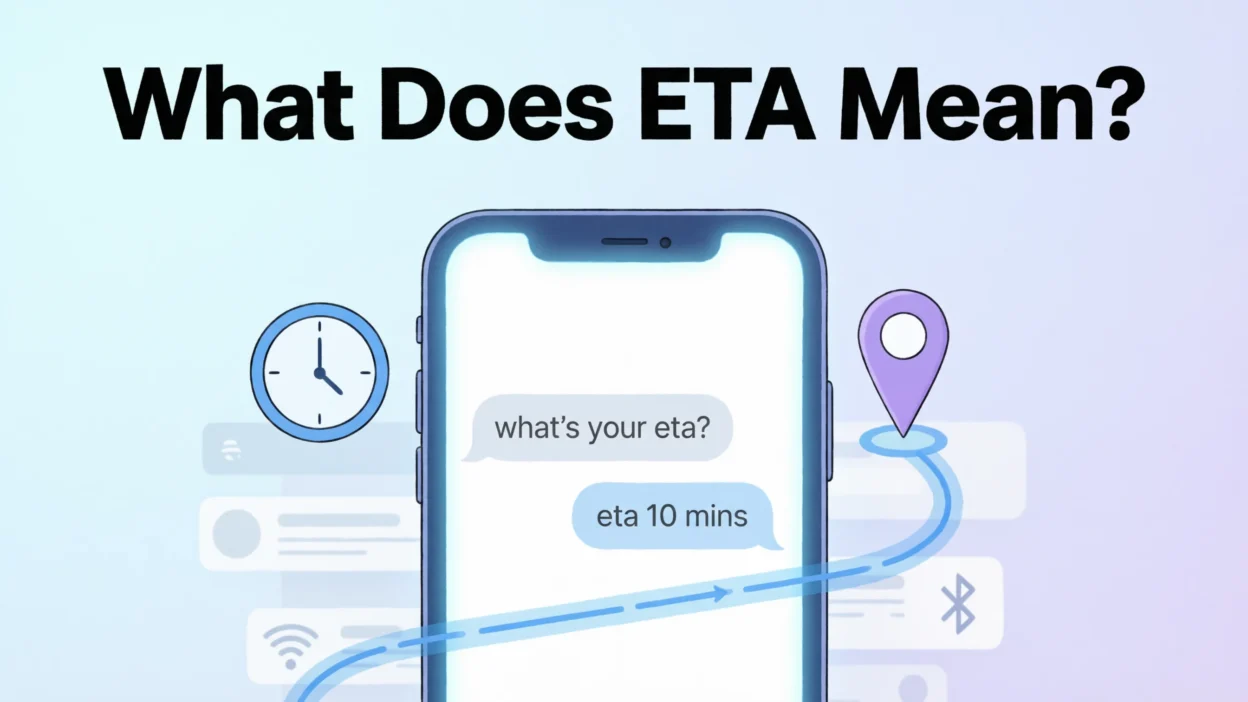
Simple Example
Friend: “where are you?”
You: “eta 10 mins.”
This tells your friend you’ll likely arrive in about 10 minutes.
Summary: ETA means “Estimated Time of Arrival” and tells someone when you expect to arrive or finish something.
Where Is ETA Commonly Used?
ETA is one of the most common texting abbreviations because it works in many different situations.
Text Messages
Friends often ask for an ETA when meeting up.
Example:
“what’s your eta?”
Social Media
People use ETA in comments, messages, and event planning discussions.
Example:
“any eta on the livestream?”
Direct Messages (DMs)
ETA helps people coordinate schedules quickly.
Example:
“my eta is around 8 pm.”
Gaming Chats
Gamers often use ETA when joining a match or returning from a break.
Example:
“eta 5 mins, starting pc now.”
Online Forums
People may ask for an ETA on updates, releases, or announcements.
Example:
“is there an eta for the next update?”
Delivery and Shipping
Delivery apps frequently show an ETA for food, packages, or rides.
Example:
“driver eta: 12 minutes.”
Workplace Communication
ETA is also common in business messages and emails.
Example:
“what’s the eta on the report?”
Tone of ETA
ETA is generally:
| Setting | Tone |
|---|---|
| Texting | Casual |
| Social Media | Casual |
| Gaming | Informal |
| DMs | Neutral |
| Work Chats | Professional |
| Emails | Professional |
| Delivery Updates | Neutral |
Unlike many internet slang terms, ETA can be used in both casual and professional communication.
Realistic ETA Conversation Examples
Here are some natural texting examples that show how people use ETA today.
Example 1
alex: where are you?
sam: eta 15 mins
Example 2
mia: dinner starts at 7
jake: got it, my eta is 6:50
Example 3
lily: when are you joining the game?
noah: eta 5 mins
Example 4
emma: did you leave yet?
oliver: yep, eta 20 minutes
Example 5
ryan: any eta on the photos?
kate: i’ll send them tonight
Example 6
zoe: the stream isn’t live yet
max: no eta from the creator so far
Example 7
ava: food taking forever
jack: app says eta 8 mins
Example 8
ella: when will the update drop?
leo: no official eta yet
Example 9
chris: almost here?
ben: yep, eta 3 mins
Example 10
sophia: are you close?
ethan: eta about 10 minutes
When to Use ETA and When Not to Use It
Understanding the right situations for ETA helps you communicate clearly.
Use ETA When
✅ Talking about arrival times
✅ Giving delivery updates
✅ Discussing project completion estimates
✅ Joining online games or meetings
✅ Asking when someone will arrive
✅ Tracking rides, food, or packages
Don’t Use ETA When
❌ Talking about exact confirmed times
❌ Discussing unrelated topics
❌ Replacing every time-related phrase
❌ Using it when no estimate exists
❌ Assuming everyone knows the abbreviation
Quick Comparison Table
| Context | Example Phrase | Why It Works |
|---|---|---|
| Meeting friends | “my eta is 15 mins” | Gives an arrival estimate |
| Food delivery | “driver eta 8 mins” | Shows expected arrival |
| Gaming | “eta 5 mins” | Indicates join time |
| Random opinion | “eta this movie is great” | Doesn’t make sense |
| Confirmed event | “eta starts at 8 pm exactly” | ETA is an estimate, not a certainty |
Similar Slang Words and Alternatives to ETA
Several words and phrases can communicate similar ideas depending on the situation.
| Term | Meaning | When to Use It |
|---|---|---|
| ETA | Estimated Time of Arrival | Arrival estimates |
| ASAP | As Soon As Possible | Urgent situations |
| BRB | Be Right Back | Short absence |
| OMW | On My Way | Traveling somewhere |
| Soon | In a short time | Casual timing |
| Arrival Time | Exact arrival information | Formal communication |
| Update | Status information | General progress updates |
| Expected Time | Predicted timing | Professional settings |
OMW
OMW means On My Way.
Example:
“omw, eta 10 mins.”
This combination is extremely common in texting.
ASAP
ASAP means As Soon As Possible.
Unlike ETA, it focuses on urgency rather than arrival time.
BRB
BRB means Be Right Back.
It’s often used in gaming and online chats.
Expected Time
This is a more formal alternative often used in business communication.
Why ETA Is Popular in Texting Culture
Modern communication moves fast.
People want quick updates without typing long messages. ETA solves this problem by communicating important timing information in just three letters.
It’s especially useful because:
- Everyone values time
- Plans change often
- Mobile communication favors short messages
- Delivery and ride-sharing apps use it regularly
- It works across different age groups
Because of this, ETA has become a standard part of online chat meaning and digital communication.
Common Misunderstandings About ETA
Although ETA is simple, some people misunderstand it.
ETA Is Not an Exact Time
An ETA is only an estimate.
Traffic, delays, weather, or other issues can change the actual arrival time.
ETA Isn’t Just for Travel
Many people think ETA only applies to vehicles.
In reality, people also use it for:
- Project completion
- Software updates
- Video uploads
- Livestreams
- Deliveries
- Gaming sessions
ETA Isn’t Internet Slang Only
Unlike many social media slang terms, ETA existed long before texting culture. It has been used in transportation, shipping, aviation, and business for decades.
Frequently Asked Questions (FAQ)
What does ETA mean in text?
ETA stands for Estimated Time of Arrival. It tells someone when you expect to arrive or complete something.
Is ETA considered slang?
Not exactly. ETA is an abbreviation rather than traditional slang. It’s commonly used in texting, social media, work communication, and transportation.
Can ETA be used in professional emails?
Yes. ETA is widely accepted in professional settings and is commonly used in business emails, project management, logistics, and customer service.
What does “what’s your ETA?” mean?
It means someone wants to know when you expect to arrive.
Do teenagers use ETA?
Yes. Teenagers, adults, professionals, gamers, and delivery services all use ETA regularly.
Is ETA only used for travel?
No. It can also refer to the expected completion time of a task, update, project, report, livestream, or delivery.
Can ETA be wrong?
Yes. Since ETA means estimated time of arrival, unexpected delays can cause the actual arrival time to be different.
Final Thought
If you’ve ever wondered what does ETA mean, the answer is simple: ETA stands for Estimated Time of Arrival. It’s a useful abbreviation that helps people quickly communicate when they expect to arrive or finish something.
Whether you’re texting friends, chatting in a gaming lobby, tracking a food order, coordinating plans on social media, or discussing work projects, ETA is one of the most practical and widely understood abbreviations in modern digital communication. Knowing how and when to use it can make your messages clearer, faster, and more effective.