Simple Meaning, Examples, and How to Use It Correctly
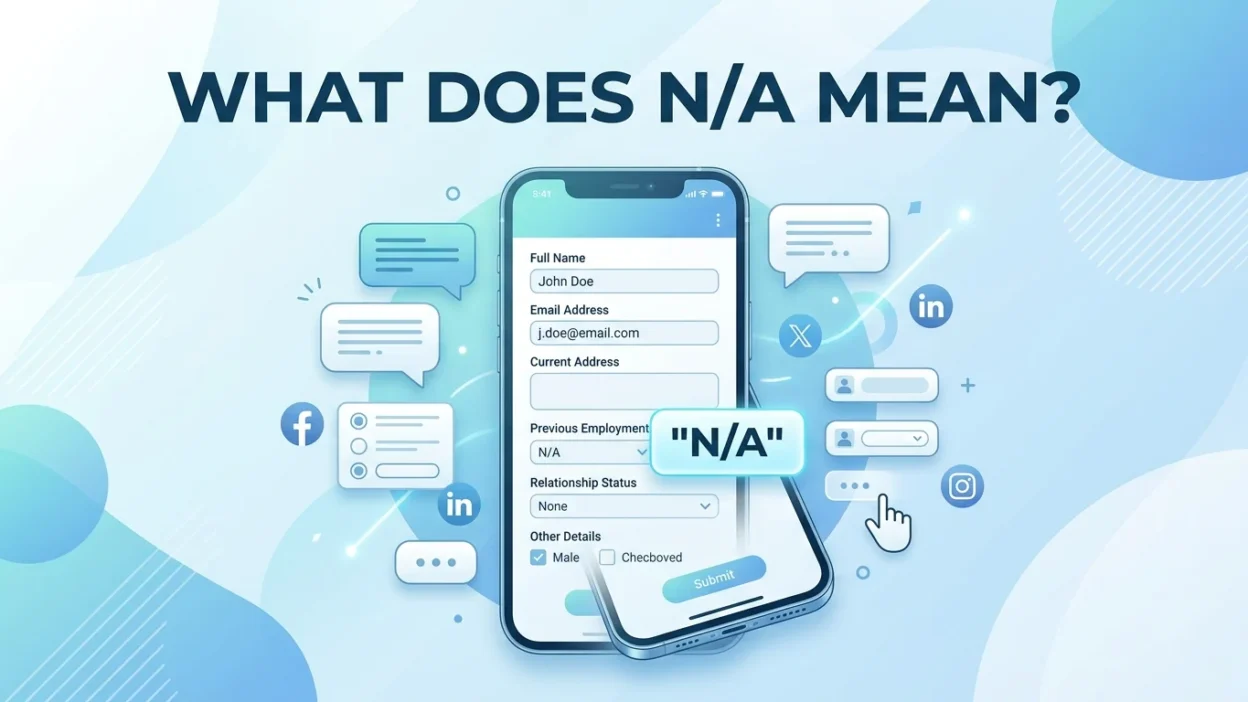
Have you ever filled out an online form, read a social media post, or looked at a chart and noticed the letters N/A? The first time many people see it, they often wonder if it’s a typo, a code, or some kind of internet slang. Maybe a friend replied with “N/A” in a chat, or you saw it in a profile field where information was missing.
Because it appears in so many places online and offline, understanding its meaning can save you from confusion. The good news is that N/A is very simple once you know what it stands for and how people use it in everyday communication.
Quick Answer: N/A means “Not Applicable” or sometimes “Not Available,” depending on the context.
What Does N/A Mean in Text?
The abbreviation N/A usually stands for “Not Applicable.” This means something does not apply to a particular situation, question, or person.
In some cases, N/A can also mean “Not Available.” This version is used when information exists but cannot be provided at that moment.
Plain-English Explanation
Think of N/A as a shortcut for saying:
- “This question doesn’t relate to me.”
- “There is no answer for this field.”
- “The information isn’t available right now.”
People use it because it is short, clear, and widely understood.
Why Do People Use N/A?
There are several reasons:
- It saves time.
- It avoids leaving blank spaces.
- It tells others that information is missing for a valid reason.
- It is commonly accepted in forms, documents, and online communication.
Example Sentence
“Middle name: N/A”
This means the person does not have a middle name or the question does not apply.
Summary: N/A means “Not Applicable” or “Not Available” and is used when information doesn’t apply or isn’t currently provided.
Where Is N/A Commonly Used?
Unlike many texting abbreviations that only appear in chats, N/A is used almost everywhere.
Online Forms
Many websites ask users to complete information fields. If a field does not apply, people often enter N/A.
Text Messages
Friends sometimes use N/A when answering a question that doesn’t fit their situation.
Social Media
You may see N/A in profiles, captions, comments, or polls when information isn’t relevant.
Direct Messages (DMs)
In private chats, people use N/A as a quick response when they have no applicable answer.
Gaming Chats
Players may use N/A when discussing stats, settings, or questions that don’t apply to their role or character.
Online Forums
Forum users often write N/A when completing profile information or responding to survey questions.
Workplace Communication
Many businesses use N/A in reports, spreadsheets, and forms to indicate missing or irrelevant information.
Tone of N/A
The tone is generally:
- Neutral
- Professional
- Formal
- Acceptable in casual conversations
Unlike most social media slang, N/A is not considered trendy or emotional. It simply communicates information efficiently.
Realistic Conversation Examples
Here are some natural examples of how people use N/A in modern texting culture:
- friend 1: what’s your middle name?
friend 2 idon’t have one. - friend 1: did you add your company website?
friend 2: put because i don’t own a business. - user: relationship status?
friend: lol, i’d rather not answer. - gamer 1: what’s your clan rank?
gamer 2: i’m not in a clan. - friend 1: what’s your office extension number?
friend 2: work remotely. - user: did you fill in the optional section?
friend: nope, just wrote. - friend 1: what was your previous address?
friend 2: , never moved before. - gamer 1: what’s your healer level?
gamer 2: , i play tank only. - friend 1: can you share the tracking number?
friend 2: , it hasn’t shipped yet. - user: did you answer every question?
friend: yeah, and i used where needed.
When to Use N/A and When Not to Use It
Understanding the right context is important.
Do Use N/A When
✅ A question does not apply to you.
✅ Information is unavailable.
✅ Completing forms with irrelevant fields.
✅ Filling out surveys.
✅ Creating reports or spreadsheets.
✅ Providing a professional response.
Don’t Use N/A When
❌ You actually know the answer.
❌ You are avoiding required information.
❌ Someone expects a detailed explanation.
❌ The question needs a real response.
❌ The information can easily be provided.
Quick Comparison Table
| Context | Example Phrase | Why It Works |
|---|---|---|
| Job application | “Previous employer: N/A” | No previous employer exists |
| Survey form | “Children: N/A” | Question doesn’t apply |
| Shipping update | “Tracking number: N/A” | Not available yet |
| Friend asks favorite movie | “N/A” | Doesn’t work because an answer is expected |
| Teacher asks homework status | “N/A” | Usually needs a real explanation |
Similar Slang Words and Alternatives
Although has a specific meaning, some alternatives may appear in similar situations.
| Term | Meaning | When to Use |
|---|---|---|
| None | Nothing exists | When there is no item or answer |
| Unknown | Information isn’t known | When data exists but isn’t available |
| Not Available | Information cannot be provided | Reports, databases, forms |
| Not Applicable | Doesn’t relate to the situation | Forms and surveys |
| No Response | Person didn’t answer | Surveys and research |
| Blank | Left empty | Informal references to missing data |
| TBD | To Be Determined | Information will come later |
| TBA | To Be Announced | Details haven’t been released yet |
N/A vs TBD
means the information doesn’t apply.
TBD means the information will be decided later.
Example:
- Wedding date: TBD
- Maiden name: N/A
N/A vs Unknown
Unknown means there should be an answer, but nobody knows it.
means no answer is needed at all.
Why N/A Remains Popular
Many internet abbreviations come and go, but has stayed useful for decades.
Its popularity comes from:
- Simplicity
- Professional acceptance
- Easy understanding
- Universal use across industries
- Compatibility with digital forms
Whether you’re texting friends, filling out documents, or participating in online chats, quickly communicates that information is either irrelevant or unavailable.
This makes it one of the most practical abbreviations in modern communication.
Frequently Asked Questions (FAQ)
What does N/A mean in texting?
In texting, N/A usually means “Not Applicable” or “Not Available.” The exact meaning depends on the conversation.
Is N/A considered slang?
Not really. It is more of an abbreviation than internet slang. It is commonly used in both formal and informal communication.
What is the full form of ?
The most common full form is “Not Applicable.” In some situations, it can also mean “Not Available.”
Is N/A rude to use in a conversation?
No. N/A is generally neutral and polite. However, if someone expects a detailed answer, using only may seem unhelpful.
Do younger people use N/A on social media?
Yes. While younger users often use newer social media slang, is still widely understood and used across all age groups.
Can N/A be used in professional settings?
Absolutely. is commonly used in workplaces, forms, reports, databases, and official documents.
Does N/A always mean the same thing?
No. It most often means “Not Applicable,” but sometimes it means “Not Available.” Context determines the correct interpretation.
Final Thought
If you’ve ever wondered what does mean, the answer is simple: it usually stands for “Not Applicable“ or “Not Available.” It is one of the most widely recognized abbreviations in both online and offline communication. Whether you’re filling out a form,
responding in a chat, updating a profile, or reviewing data, helps clearly show that information either doesn’t apply or isn’t available. Because it’s short, professional, and easy to understand, remains an important part of modern texting culture, online chat meaning, and everyday digital communication.