Have you ever been scrolling through homework help posts, math comments, or even a group chat where someone suddenly says “these two lines are perpendicular,” and you pause for a second thinking, what does that even mean? It’s one of those words that sounds more complicated than it really is.
Many students first meet it in geometry class, often while drawing lines or shapes on paper. At first, it can feel confusing, but once you see a simple example like the corner of a notebook or a wall meeting the floor, it suddenly clicks. This guide breaks everything down in a super easy way so you’ll never feel lost when you see the word again.
Quick Answer: What does perpendicular mean?
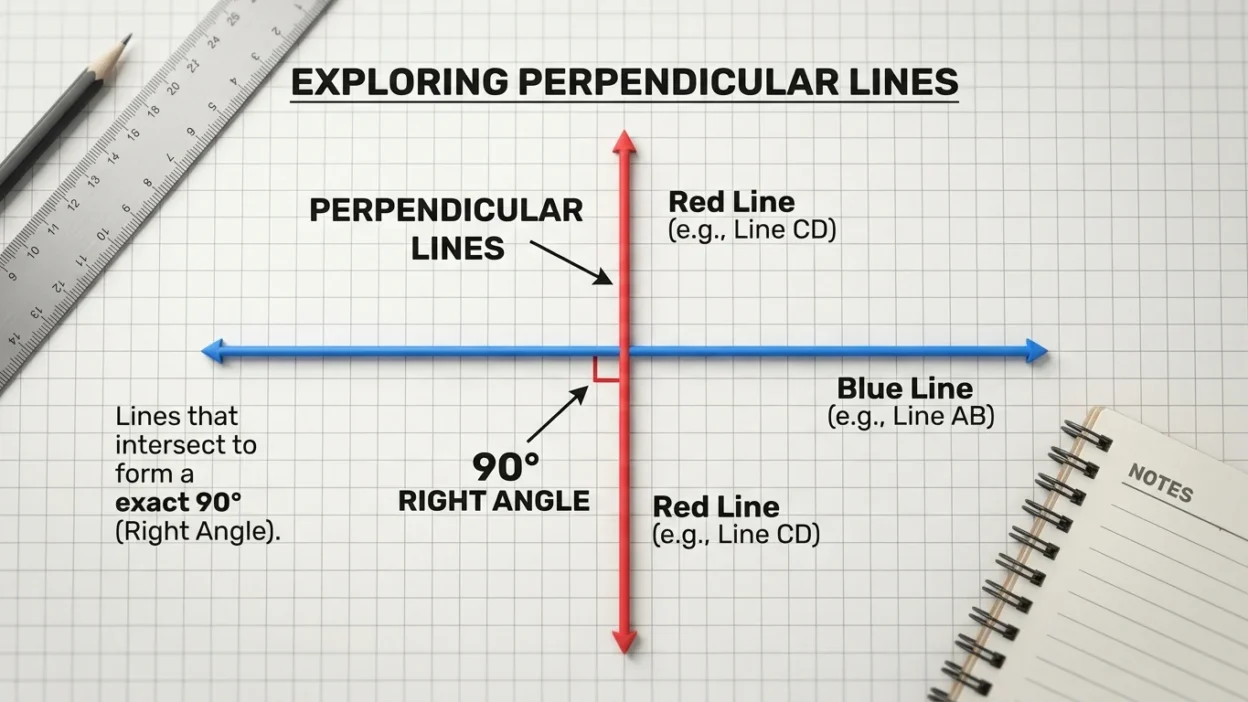
Perpendicular means two lines or surfaces meet or cross each other at a perfect 90-degree angle (a right angle).
Meaning of Perpendicular in Simple Words
The word perpendicular is not slang or texting shorthand. It comes from geometry, a branch of math that studies shapes, lines, and angles.
In plain English, perpendicular describes when two lines, walls, or surfaces meet in a perfect “L” shape. The most important part is the angle they form — it must be exactly 90 degrees, also called a right angle.
People use this word because it helps clearly describe precise shapes and positions in math, design, construction, and even maps.
Simple example sentence:
- The flagpole is perpendicular to the ground.
Bold Summary: Perpendicular means two lines or surfaces meet at a perfect 90-degree (right) angle.
Where is the Term “Perpendicular” Commonly Used?
Unlike internet slang or texting abbreviations, what does perpendicular mean is mainly used in formal and academic settings.
You will most commonly see it in:
- Math class (geometry lessons)
- Science and physics diagrams
- Architecture and building design
- Engineering drawings
- Computer graphics and game design maps
The tone of the word is formal and neutral, not casual or informal. You usually won’t see it in casual texting unless someone is talking about school or explaining a concept.
For example, in a geometry problem or a design plan, people use “perpendicular” to make instructions clear and exact.
7–10 Realistic Chat Examples (Modern Style)
Even though it’s not slang, here are how real students or learners might use it in chats or online study groups:
- student1: bro i don’t get this question
student2: just draw the line perpendicular to the base - me: what does perpendicular even mean
friend: it means a perfect 90 degree angle like an L shape - teacher: make sure the sides are perpendicular
student: ok got it drawing it now - alex: is this line straight?
sam: nah it should be perpendicular to the bottom line - groupchat: anyone know how to do this geometry part
reply: yeah just make the lines perpendicular - me: i keep messing this up
friend: think of a corner of a book, that’s perpendicular - student: are these lines parallel?
tutor: no, they’re perpendicular, they meet at a right angle - chat: this diagram is confusing
reply: look for the perpendicular lines first - me: quick question what’s perpendicular again
friend: L-shaped meeting lines, 90 degrees
When to Use and When Not to Use “Perpendicular”
Understanding what does perpendicular mean also includes knowing when it’s the right word to use.
✔️ When to use it:
- Talking about geometry or math problems
- Describing shapes, lines, or angles
- Explaining architecture or building design
- Writing school assignments or technical explanations
- Discussing diagrams or maps
❌ When NOT to use it:
- Casual texting about daily life
- Social media captions (unless educational)
- Gaming slang conversations
- Emotional or informal chats
- Replacing simpler words like “straight” or “corner”
Quick Comparison Table
| Context | Example Phrase | Why it works / doesn’t |
|---|---|---|
| Math class | “Draw a perpendicular line.” | Correct, precise geometry term |
| Casual chat | “That wall is perpendicular lol” | Sounds unnatural in casual tone |
| School homework | “These lines are perpendicular.” | Perfect formal usage |
| Gaming chat | “Perpendicular enemy spotted” | Not natural, wrong context |
Similar Words and Alternatives
If you are learning what does perpendicular mean, it helps to know similar geometry terms:
1. Parallel
Lines that never meet and stay the same distance apart.
2. Intersecting
Lines that cross each other at any angle (not necessarily 90°).
3. Orthogonal
A more advanced math term that also means 90-degree relationship (used in higher math and coding).
4. Right angle
A 90-degree angle itself, often used instead of saying perpendicular.
5. Perpendicular bisector
A line that cuts another line into two equal parts at a right angle.
These words are often used together in geometry lessons and diagrams.
FAQs About “What Does Perpendicular Mean”
1. Is perpendicular a slang word?
No, it is not slang. It is a formal geometry term used in math and technical fields.
2. What is a simple way to understand perpendicular?
Think of the corner of a book, wall, or square shape — that is perpendicular.
3. Do people use perpendicular in texting?
Rarely. It is mostly used in educational or technical conversations, not casual texting.
4. What angle is perpendicular?
Perpendicular lines always form a 90-degree angle.
5. Is perpendicular the same as parallel?
No. Parallel lines never meet, but perpendicular lines cross at a right angle.
6. What grade level learns perpendicular?
It is usually introduced in middle school math (around grade 5–7).
7. Why is perpendicular important in real life?
It is used in building construction, design, maps, engineering, and even computer graphics to ensure accuracy.
Final Thought
Now that you clearly understand what does perpendicular mean, it’s easy to see that it’s not a confusing or random word. It simply describes a very specific and important relationship between two lines or surfaces — a perfect 90-degree angle. While it may not appear in everyday texting or social media slang, it plays a big role in math, design, and real-world structures. Once you start noticing it around you — in buildings, books, or drawings — the concept becomes second nature.

Michel Clark is an emerging author and content creator behind Ribacks.com, where he writes insightful articles on [your niche/topics e.g., lifestyle, tech, personal growth]. Known for fresh perspectives and engaging storytelling, Clark is building a growing readership with thoughtful writing and meaningful connections in the online community.