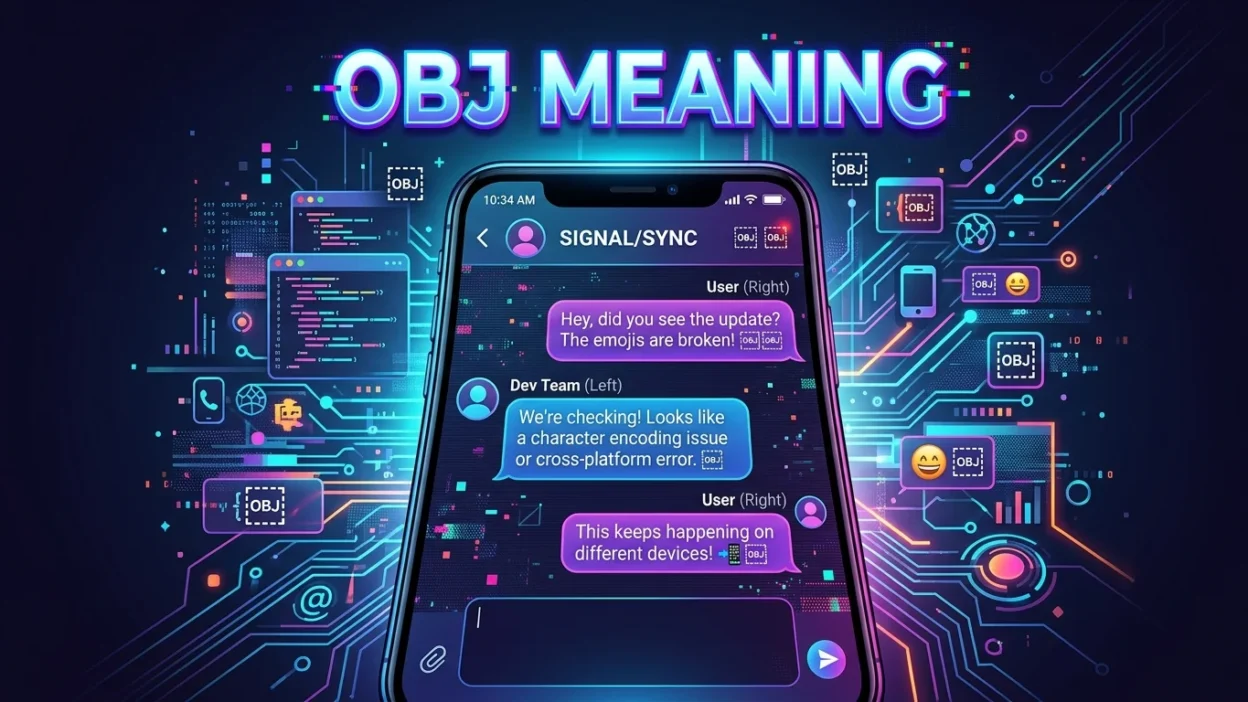
Have you ever been scrolling through a chat or social media post and suddenly seen something like “OBJ” appear in a message where an emoji or symbol should be? At first, it feels confusing—almost like a glitch. You might wonder if it’s a secret code, a new slang word, or just a typo.
Many people first notice OBJ when a message doesn’t display properly, especially on older phones or different apps. Instead of showing the actual emoji or symbol, the system replaces it with “OBJ,” which can make conversations look strange or broken. Once you understand it, though, it becomes a lot less mysterious and actually pretty simple.
Quick Answer: OBJ means a missing or unsupported object/emoji in a message, shown when a device cannot display the original symbol correctly.
What Does OBJ Mean in Text?
In most online chats and digital communication, OBJ is short for “Object Replacement Character.” It is not a slang word people intentionally type. Instead, it appears automatically when a device or app cannot display a specific emoji, icon, or special symbol.
Plain-English Explanation
When you see OBJ, it usually means:
- An emoji did not load properly
- A symbol is not supported on your device
- The app cannot recognize the character
- A file or special object cannot be displayed
Instead of showing a blank space or broken icon, the system uses OBJ as a placeholder.
Why People See OBJ
People don’t usually “use” OBJ on purpose. It appears because of technical reasons like:
- Different phone operating systems (Android vs iPhone)
- Outdated software versions
- Unsupported emojis or fonts
- Cross-platform messaging issues
- App compatibility problems
Example Sentence
“he sent a message full of emojis, but my phone only showed obj everywhere.”
Summary: OBJ is a system-generated placeholder that appears when a device cannot display an emoji or special character.
Where Is OBJ Commonly Used or Seen?
Even though OBJ is not intentional slang, it appears in many places in modern digital communication.
Text Messages
OBJ often shows up in SMS or chat apps when emojis sent by another user are not supported.
Social Media Platforms
You may see OBJ in:
- Instagram comments
- Facebook posts
- TikTok captions
- X (Twitter) threads
This usually happens when content is shared across different devices.
Direct Messages (DMs)
Private chats are one of the most common places where OBJ appears, especially in cross-platform conversations.
Gaming Chats
In online games, players sometimes see OBJ when special icons or emojis fail to load.
Forums and Websites
Older forums or unsupported browsers may display OBJ instead of symbols or embedded objects.
Tone of OBJ
The tone is:
- Neutral
- Technical
- Unintentional
It is not emotional slang and does not carry any meaning like typical chat abbreviations.
Real Conversation Examples Using OBJ
Here are realistic examples of how OBJ appears in everyday online communication.
- “i sent you emojis but it shows obj on your phone?”
- “your message is full of obj symbols, i can’t read it properly.”
- “why does my chat keep turning emojis into obj?”
- “he replied with obj instead of the emoji i sent.”
- “this app is broken, everything shows obj now.”
- “i think your phone doesn’t support those emojis, it shows obj.”
- “i updated the app and the obj issue is gone.”
- “her message had obj everywhere so i couldn’t understand the tone.”
- “some stickers appear as obj on older devices.”
- “obj keeps showing in group chat when someone uses new emojis.”
These examples show that OBJ is not part of conversation meaning—it is a display issue.
When to Use OBJ and When Not to Use It
Since OBJ is not a real slang term, it is not something you intentionally use in communication. However, understanding it helps you recognize technical issues.
When OBJ Appears (You Don’t Use It Manually)
✔ When emojis are unsupported
✔ When apps fail to render symbols
✔ When devices are outdated
✔ When cross-platform messages break formatting
When Not to Use OBJ
❌ Do not type OBJ as slang
❌ Do not use it in professional writing
❌ Do not include it in formal messages
❌ Do not treat it as an abbreviation for words
❌ Do not use it instead of emojis intentionally
Context Comparison Table
| Context | Example Phrase | Why It Happens |
|---|---|---|
| Text Message | “shows obj instead of emoji” | Unsupported emoji |
| Social Media | “post appears with obj icons” | Cross-platform issue |
| Gaming Chat | “obj appears in chat box” | Font or symbol mismatch |
| Work Email | “obj used in report” | Incorrect usage |
| Academic Writing | “obj meaning analysis” | Not relevant in formal writing |
Similar Terms and Alternatives
When people see OBJ, they often confuse it with other missing-symbol indicators or slang-related placeholders.
1. Missing Emoji Box (☐ / □)
This appears when a device cannot render a character at all.
2. Tofu Box
A nickname for empty square boxes that replace missing symbols.
3. Broken Emoji (�)
A replacement character that shows when text cannot be decoded properly.
4. Placeholder Symbol
A general term for any symbol used when content is missing.
5. Unsupported Character Warning
Some apps explicitly show a warning instead of OBJ.
6. Blank Space Error
Sometimes the system leaves an empty gap instead of showing OBJ.
Key Difference
- OBJ = system label for missing object/emoji
- Tofu box / broken emoji = visual placeholder
- Missing character = general term
All of them point to the same issue: the device cannot display the original content.
Why OBJ Happens in Modern Digital Communication
Modern texting culture depends heavily on emojis, stickers, and special symbols. But not all devices support the same updates at the same time.
Common reasons include:
- New emojis released by Unicode not yet supported on older phones
- Differences between Android, iOS, and web apps
- App version mismatches
- Corrupted message data during transmission
As digital communication grows more visual, issues like OBJ appear more often across social media slang environments and chat shorthand systems.
How to Fix OBJ Issues
If you frequently see OBJ in messages, here are simple fixes:
- Update your phone software
- Update messaging apps
- Ask the sender to resend without new emojis
- Switch to a different chat app
- Clear app cache (on Android devices)
These steps usually restore proper emoji display.
FAQ About OBJ Meaning
What does OBJ mean in text messages?
OBJ means a missing or unsupported emoji or symbol that cannot be displayed properly on your device.
Is OBJ a slang word?
No. OBJ is not slang. It is a system-generated placeholder for unsupported characters.
Why do I see OBJ instead of emojis?
You see OBJ when your device or app cannot display certain emojis, icons, or special characters.
Can I use OBJ in texting?
No. It is not something you intentionally use. It appears automatically due to technical issues.
Does OBJ mean something different in gaming?
In most cases, it still refers to missing or unsupported symbols, not a gaming slang term.
Is OBJ a virus or error?
No. It is not a virus. It is a harmless display issue related to encoding or compatibility.
How do I stop seeing OBJ in chats?
Update your device, update apps, or ensure both users are using compatible platforms.
Final Thought
The OBJ Meaning in texting and online communication is not a slang term but a technical placeholder that appears when emojis or symbols cannot be displayed properly. In today’s emoji-heavy digital world, it is common to see OBJ in messages across social media, gaming chats, and texting apps. Understanding it helps you avoid confusion and recognize that nothing is wrong with the message itself—just the way your device is reading it. As texting culture continues to evolve, knowing terms like OBJ makes online communication smoother and easier to understand.